


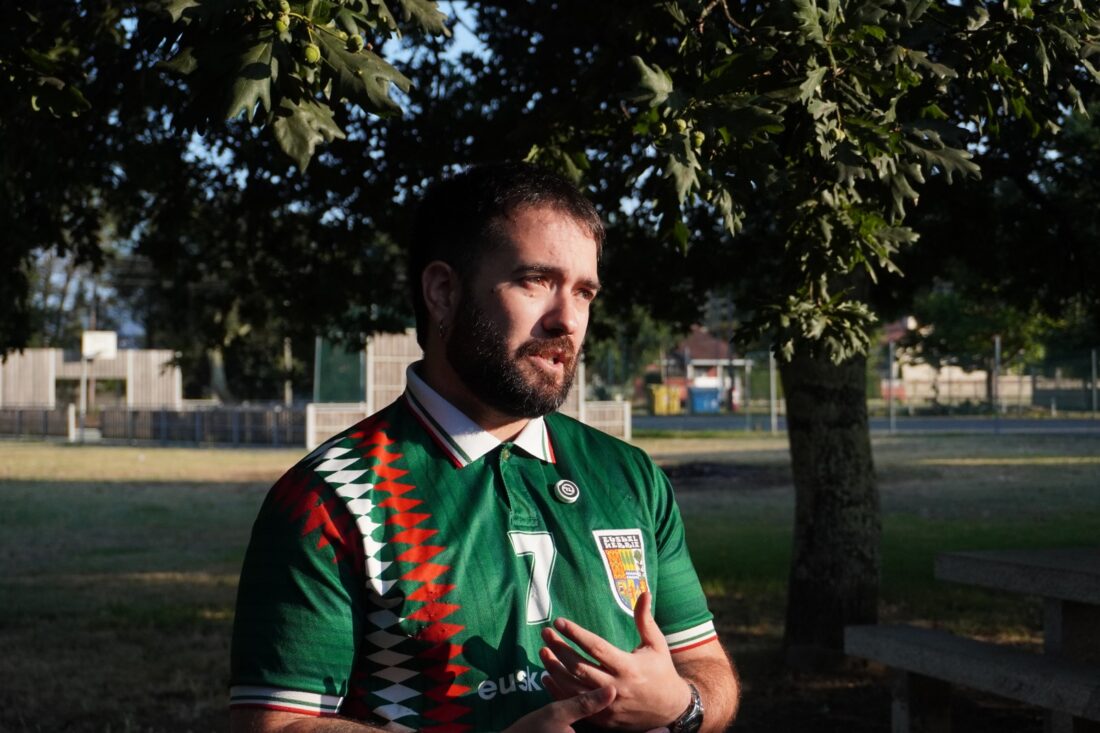
Gorka Martín: “Illegal detectorists, through the looting of archaeological sites, destroy the archaeological contexts of research”
The postdoctoral researcher at the University of the Basque Country opened the Fortalezas da Fronteira BARferências cycle this Monday with the lecture ‘Metal Detectors and Archaeology: What Not to Do’
The BARferencias cycle organised by Fortalezas da Fronteira began this Monday at Novo Bar, in Carregal, with a talk by University of the Basque Country postdoctoral researcher Gorka Martín Echevarría, entitled Metal Detectors and Archaeology: What Not to Do. The session served to bring the public closer to a key issue in heritage protection: the dangers of the unauthorised and non-systematic use of metal detectors in archaeological contexts.
During his presentation, Martín explained that his line of research focuses on conflict archaeology and battlefield archaeology, a field in which metal detectors can be used as a scientific tool when they are employed within a controlled, systematic and recorded procedure. However, he warned that they are also a “controversial” tool because of the misuse historically made of them.
The researcher pointed out that one of the greatest risks to archaeology worldwide is looting carried out using metal detectors. This practice consists of extracting metal objects from fields, sites or areas with archaeological potential without scientific control, causing not only the loss of the artefacts themselves, but also of the information that accompanies them.
In this regard, Martín stressed that the archaeological value of an object does not lie solely in the item itself, but in its context. He explained that a Roman coin collected in isolation or at random loses much of its ability to contribute to historical knowledge, whereas truly useful information comes from the set of elements surrounding it: structures, non-metallic materials, spatial distribution and relationships with the rest of the site.
For this reason, the use of metal detectors without archaeological methodology, without recording and without the systematic collection of data is especially harmful to research. As he explained, these practices disrupt the reading of archaeological sites and make it harder to rigorously reconstruct the past.
Martín also drew attention to the social and ethical dimension of this problem, recalling that archaeological heritage is a common good. The removal of materials without authorisation amounts, he explained, to the privatisation of a heritage that belongs to society as a whole.
The lecture opened the BARferencias programme by Fortalezas da Fronteira, an initiative that seeks to bring archaeology, history and the memory of the borderlands into nearby, everyday spaces, encouraging dialogue between specialists, local residents and interested members of the public. During the talk, he also analysed the battles of Little Bighorn, where archaeologists such as Douglas Scott used detectors and GPS mapping to discover more than 5,000 artefacts. The cycle will continue over the coming days with new sessions on Roman mining in the Baixo Miño, the fortified landscape of Tui and the Miño valley, heritage education and the memory of border territories. These activities form part of the open programme of the archaeological project around As Torres, in San Miguel de Taborda, Tomiño, which is part of an international volunteer camp organised by the Xunta de Galicia.
No Comments